- A plan can be complete and still fail, because people lose roughly a third of their higher processing ability during a crisis.
- Eight questions separate a plan written for review from a plan written for use.
- WorldSafe built a free check that scores your answers, ranks the gaps by severity, and says what closing each one takes. Take it here.
In most of the buildings I walk, the plan exists. Someone wrote it, someone approved it, and it sits in a binder or a shared drive where an auditor can find it. The organization is not negligent. It did the work.
Then something happens, and the plan is not what fails first. Access to it fails first.
What pressure does to decision-making
Research on decision-making under acute stress puts the loss of higher processing ability at around a third. A colleague of mine describes it more bluntly: everyone’s IQ drops 20 points in an emergency.
Take that seriously and it changes what a good plan looks like. A document that reads clearly in a conference room on a Tuesday afternoon is being evaluated by a different brain than the one that will open it. Most plans are written for review. Very few are written for use.
The practical test is short. If a plan requires someone to stop and interpret it during a crisis, it is too complicated.
The first 15 minutes belong to nobody
The failures cluster in a narrow window, and they repeat across industries and organization sizes. Ownership is unclear. Escalation is delayed. Information conflicts. Nobody is certain who has the authority to make a call. People wait for someone else to act.
Part of the cause is structural. A lot of organizations treat response as beginning when leadership convenes. In practice it begins the moment uncertainty enters the building, which is usually 15 or 20 minutes earlier. That gap belongs to whoever is standing there, and they are working from whatever they can reach on their phone.
Ownership without a failover
Almost every organization names a primary decision maker. Far fewer define what happens when that person is on a plane, in surgery, on leave, or directly involved in the incident.
IT solved this decades ago. No competent team runs a critical system without a documented failover, and they test it. Physical security frequently runs on a single point of failure and calls it a plan.
Four questions worth answering in writing: who owns communications, who is accountable for people, who makes operational decisions, and who backs up each of those. Anything unclear beforehand stays unclear during the event, except louder.
Right-sized readiness
The instinct after reading something like this is to prepare for everything. Preparing for everything means you are ready for nothing.
Scope by threat, vulnerability, and consequence together. A threat that does not apply to your building is noise. A vulnerability with no meaningful consequence is a maintenance ticket. The work sits where all three meet: what could realistically happen here, how exposed you are to it, and what it would cost you.
The same logic applies to training. An annual all-hands session satisfies a requirement and teaches very little. Fifteen minutes on one subject, run quarterly, built around something that happened recently and nearby, does more. Our teams call it a tune-up. It fits in a staff meeting.
The eight questions
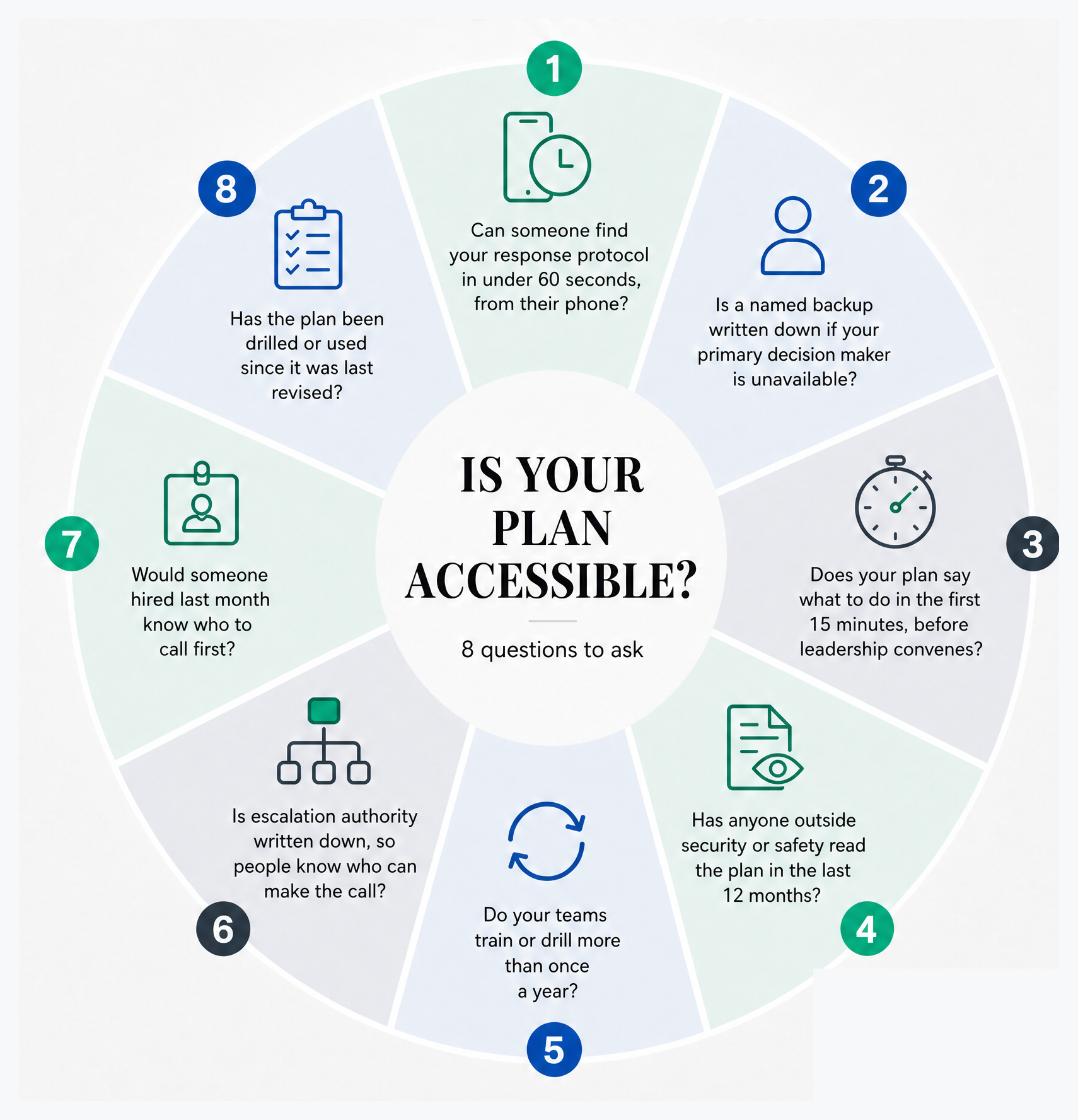
These are the questions I ask when I want to know whether an organization’s information will survive contact with a real event.
- Can someone find your response protocol in under 60 seconds, from their phone?
- If your primary decision maker is unavailable or directly involved, is a named backup written down?
- Does your plan say what to do in the first 15 minutes, before leadership convenes?
- Has anyone outside the security or safety function read the plan in the last 12 months?
- Do your teams train or drill more than once a year?
- Is escalation authority written down, so people know who can make the call?
- Would someone hired last month know who to call first?
- Has the plan been drilled or used since it was last revised?
Eight yeses is rare. Most organizations land in the middle, strong on documentation and thin on reach.
A tool that scores it
We built the check as a page you can finish in about two minutes. It asks the 8 questions, ranks every gap by severity, gives you the fixes, and estimates the time involved. Several of them take no more than an hour.
Could your team find the plan in 60 seconds?
Eight questions, about two minutes, a scored result with every gap ranked by severity.
Take the checkMore in The Employee Safety Podcast
Much of the thinking here came out of a conversation with Peter Steinfeld on AlertMedia’s The Employee Safety Podcast. The recap is here, and the full episode is on AlertMedia.
Plans do not save people. Access to information saves people.